
Why Your Website Gets Traffic But No Sales: 7 Reasons and Fixes
Picture this: your analytics dashboard looks healthy. Traffic is up, sessions are up – and yet your inbox stays quiet and sales stay flat.
If that sounds familiar, here’s the uncomfortable truth: you don’t have a traffic problem. You have a website conversion rate optimization problem. Attracting visitors is only half the job; the other half is giving those visitors a clear, credible, compelling reason to take the next step.
The good news? Conversion problems are rarely mysterious. In our work with businesses across FinTech, healthcare, legal, and hospitality, we see the same seven leaks over and over. Here’s each one – and exactly how to fix it.
First, a Hard Truth: Traffic ≠ Revenue
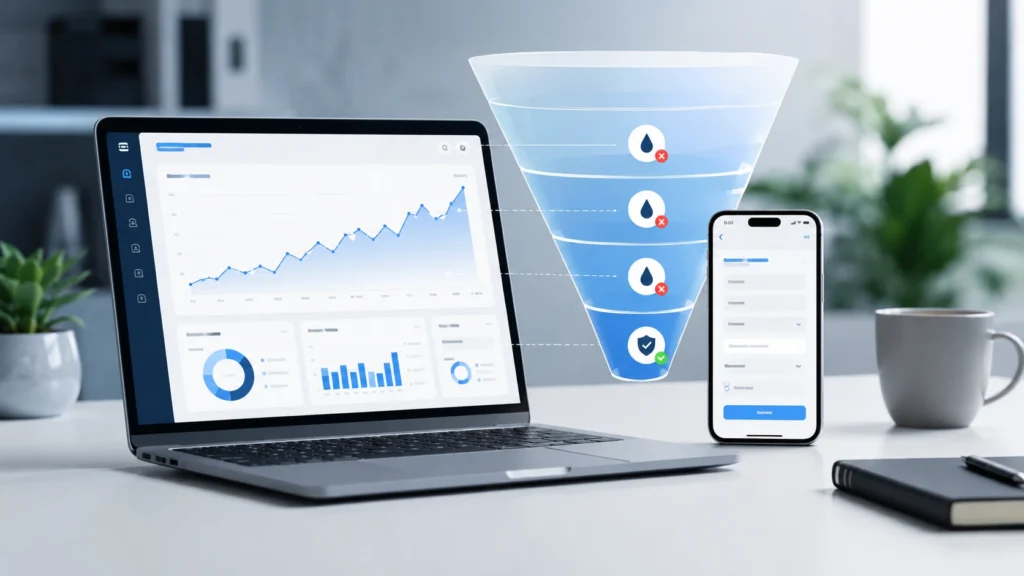
Traffic is a vanity metric if your funnel is leaking. Think of your website as a bucket you’re pouring expensive water into – ads, SEO, and social all cost time and money. If the bucket has holes, pouring more water in won’t fix it.
That’s why optimizing conversions is almost always the highest-ROI work you can do: it multiplies the value of the traffic you already pay for. Before spending another dollar on clicks, check these seven holes first.
The 7 conversion killers at a glance
| # | Reason | Tell-tale sign in your analytics | First fix to try |
| 1 | Wrong-intent traffic | High visits, low time on page, no CTA clicks | Audit real search queries in Search Console |
| 2 | Weak value proposition | High bounce on homepage & landing pages | Rewrite your headline around the customer outcome |
| 3 | Slow load times | High mobile bounce, poor Core Web Vitals | Compress images, cut heavy scripts |
| 4 | Vague or buried CTAs | Visitors browse many pages, never act | One clear primary action per page |
| 5 | Missing trust signals | Sessions die on pricing or enquiry pages | Add reviews, case studies, real faces |
| 6 | Friction-heavy forms/checkout | Abandonment spikes mid-form | Cut fields to the absolute essentials |
| 7 | Poor mobile experience | Mobile conversion far below desktop | Rebuild key pages mobile-first |
1. You’re Attracting the Wrong Traffic (Intent Mismatch)
If your pages rank for informational queries – “what is bookkeeping software,” “free logo templates” – you’ll attract researchers, students, and DIY-ers. They were never going to buy.
High traffic with near-zero enquiries usually means your content answers questions your buyers aren’t asking.
The fix: match content to buyer intent
- Open Google Search Console and review the actual queries bringing people in. Words like pricing, hire, near me, and vs signal buyers; what is, free, and template signal researchers.
- Give each audience its own page: blog content for researchers, sharp service pages for buyers.
- Don’t fear repelling the wrong clicks. Stating who you serve and what it costs filters out tyre-kickers and lifts lead quality.
2. Your Value Proposition Doesn’t Land in 5 Seconds
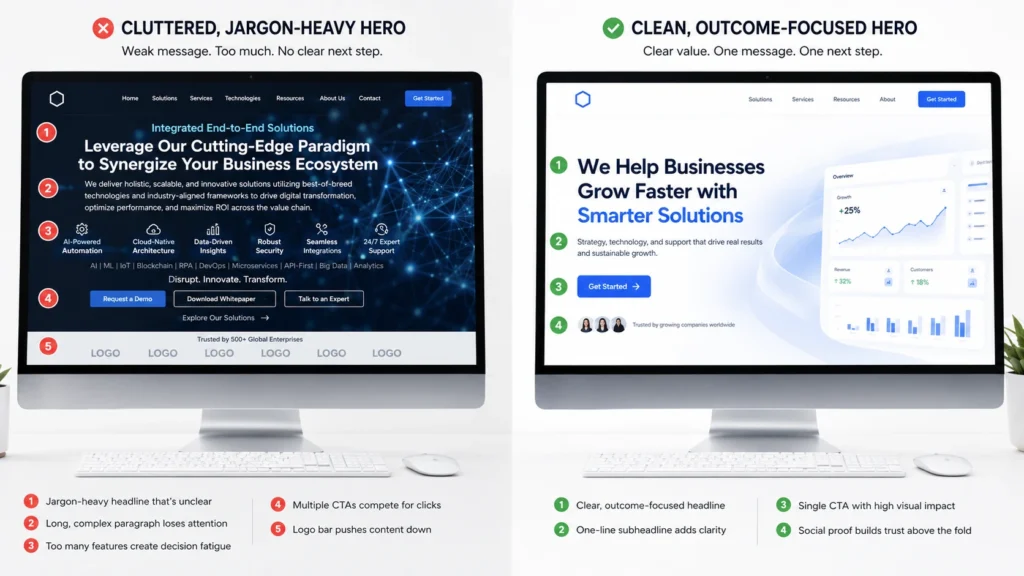
Research shows visitors form a first impression of your site in about 50 milliseconds, and decide within seconds whether to stay (Nielsen Norman Group). If your headline is “Welcome to Our Company” or industry jargon, visitors have to work to understand what you do. Most won’t.
The fix: sharpen your above-the-fold message
- Lead with the outcome you deliver. “Accounting for restaurants, without the stress” beats “Leading accounting solutions since 2009.”
- Add a one-line subheadline: who you help, how, and why you’re different.
- Keep one visible CTA above the fold.
- Apply the “so what?” test: read it to someone outside your industry. If they can’t repeat what you sell, rewrite it.
3. Slow Load Times Are Silently Killing Your Conversion Rate
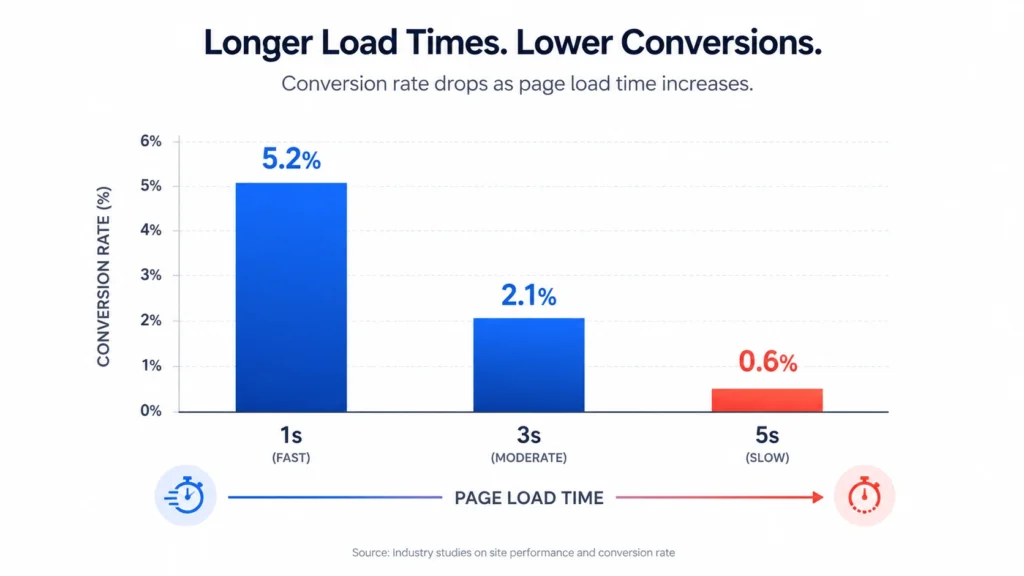
Speed isn’t a technical nicety – it’s a revenue lever. Portent’s research found that sites loading in one second convert roughly three times better than sites taking five seconds. Every extra second chips away at patience and trust, especially on mobile networks.
The fix: treat speed as a sales project
- Run your key pages through Google’s PageSpeed Insights and fix what it flags first.
- Compress images, remove unused plugins and scripts, and use caching plus a CDN.
- Aim for healthy Core Web Vitals – Google’s benchmarks for fast, stable pages.
- If your platform is fundamentally slow, that’s a rebuild conversation. It’s exactly why Vebrixa builds every site on a fast-loading, performance-first foundation – see our web development, UI/UX, and SEO services.
4. Your Calls-to-Action Are Vague, Weak, or Buried
Most websites make visitors guess what to do next. A grey “Submit” button in the footer isn’t a call to action; it’s a suggestion. And when you offer five equally weighted actions, visitors often take none.
The fix: one clear next step per page
- Decide each page’s single most valuable action and design around it.
- Use specific, action-oriented labels: “Book a free consultation” beats “Contact”; “Get my quote” beats “Submit.”
- Repeat the CTA after key sections on long pages – not just at the bottom.
- Make it visually unmissable: contrast, whitespace, and size matter.
5. Visitors Don’t Trust You Enough to Buy
Every enquiry is a small act of trust. If your site looks templated, shows no faces, no reviews, and no proof you’ve done this before, visitors drift to a competitor who shows their work. This matters double in healthcare, finance, and law – anywhere people hand over money or sensitive data.
The fix: bake trust signals into every page
- Use specific testimonials: name, context, result. “They rebuilt our site and bookings doubled” beats “Great service!”
- Publish real case studies with numbers and photos.
- Build a genuine About page with real people – credibility starts with showing who’s behind the work.
- Surface Google or Trustpilot reviews, security badges, and clear contact details with a physical address.
6. Your Checkout or Enquiry Form Is Full of Friction
Baymard Institute’s long-running research puts the average cart abandonment rate at around 70% – and the top reasons are pure UX failure: forced account creation, checkout processes that are too long or complex, and surprise costs.
Every extra field, step, or page you add quietly taxes your conversion rate.
The fix: remove every unnecessary step
- Cut forms to the minimum needed to respond – name, email, and one context field is often enough.
- For stores: guest checkout, autofill, all costs upfront, and a visible progress indicator.
- Test the flow yourself on a phone, one-handed, in a hurry. Every irritation you feel is a drop-off point for customers.
7. Your Mobile Experience Is Failing the Majority of Your Visitors
Around 60% of global web traffic now comes from mobile devices (Statista) – and for local businesses like restaurants and clinics, it’s often higher. If your mobile conversion rate is a fraction of desktop’s, your site wasn’t designed mobile-first; it was shrunk.
The fix: design mobile-first, not mobile-last
- Compare mobile vs. desktop conversion in GA4 – the gap is your opportunity.
- Use large tap targets, short forms, and click-to-call buttons for local businesses.
- Banish tiny text, hover-only information, and pop-ups that swallow the screen.
- Test on real devices, not just a resized browser window.
A Simple Website Conversion Rate Optimization Process That Actually Works
CRO isn’t a one-off redesign; it’s a loop:
- Measure – find the biggest leak with GA4, Search Console, and session recordings.
- Hypothesize – “If we shorten the enquiry form, completions will rise.”
- Change and test – one meaningful change at a time; A/B test where traffic allows.
- Repeat – small, compounding wins beat one big gamble.
That iterative mindset is baked into how Vebrixa builds websites. Our four-step process – Discover → Design → Develop → Launch & Grow – treats launch day as the starting line, not the finish line. (You can read more about how we work.)
Frequently Asked Questions
Most ecommerce sites sit around 2-3%, with top performers clearing 4-5%; lead-generation sites vary by industry. Rather than chasing a global average, track your own baseline and aim to beat it month over month.
Usually a mix of wrong-intent traffic and pages that don’t persuade: unclear value proposition, weak CTAs, or missing trust signals. Check your Search Console queries and watch a few session recordings – the problem is usually visible within minutes.
Quick wins – speed fixes, clearer CTAs, shorter forms – can move the needle in 2-4 weeks. Larger changes validated with A/B tests typically need 60-90 days of data, depending on your traffic volume.
Yes – that’s the entire point. If 1,000 monthly visitors produce 10 enquiries, doubling your conversion rate produces 20 from the same traffic. It’s the cheapest growth lever most businesses never pull.
Start yourself – the checklist above covers the highest-impact fixes. Bring in an agency when you need design and development speed, structured testing, or an expert second opinion. A good one will tell you honestly whether you even need them.
Final Thoughts: Stop Pouring Traffic Into a Leaky Bucket
Traffic without conversion is just expensive window-shoppers. Fix intent, message, speed, CTAs, trust, friction, and mobile – in that order – and the visitors you already pay for start producing real revenue. That’s website conversion rate optimization in a sentence: fall in love with fixing the funnel, not just filling it.
Not sure where your funnel leaks? Get a free website audit from Vebrixa – we’ll show you exactly what’s holding your site back and what to fix first. And for more practical, no-fluff guides, browse our blog.