
Restaurant Website Design: Menu, Online Ordering & Local SEO Guide
It’s 7:15 PM on a Friday. A couple nearby is hungry, tired, and can’t agree on dinner. One of them types “best pasta near me” into Google and taps your restaurant.
Your site opens with a slow-loading video, then serves up the menu as a PDF that won’t zoom properly on a phone. Thirty seconds later, they’re ordering from the place next door – the one with a tappable menu and a one-click order button.
That scene repeats hundreds of times a month for every restaurant with a weak website. Which is why smart restaurant website design isn’t about looking fancy. Done right, restaurant web development is a quiet, 24/7 host that shows the menu, takes the order, and fills tables while you run the floor.
Why Restaurant Website Design Is Your Most Profitable Table
Here’s the thing most owners miss: your website already gets decided votes every day, whether you optimize it or not.
A survey covered by Restaurant Dive found that 77% of diners visit a restaurant’s website before dining in or ordering out. Other industry research goes further – the vast majority of guests check a site before ordering, and about three-quarters want to see the menu and order online.
Meanwhile, third-party marketplaces only rent you customers. They hide your brand between competitors and charge for the privilege. Your own website is the only channel where the menu, the margins, and the customer relationship all belong to you.
Think of it this way: your dining room seats maybe 60 people. Your website seats everyone with a phone.
The Mobile Menu: The Heart of Restaurant Website Design
Well over half of your website traffic comes from phones – often two-thirds or more. Those visitors are standing on a sidewalk or sitting on a couch deciding dinner right now. Your menu has about ten seconds to win them.
Why PDF Menus Fail
The PDF menu feels convenient – it’s what you hand the printer, after all. But on a phone it’s a pinch-and-zoom nightmare, and for Google it’s practically invisible: search crawlers struggle to read PDF content, so it generates almost zero search traffic.
You’re hiding your best product from both customers and search engines.
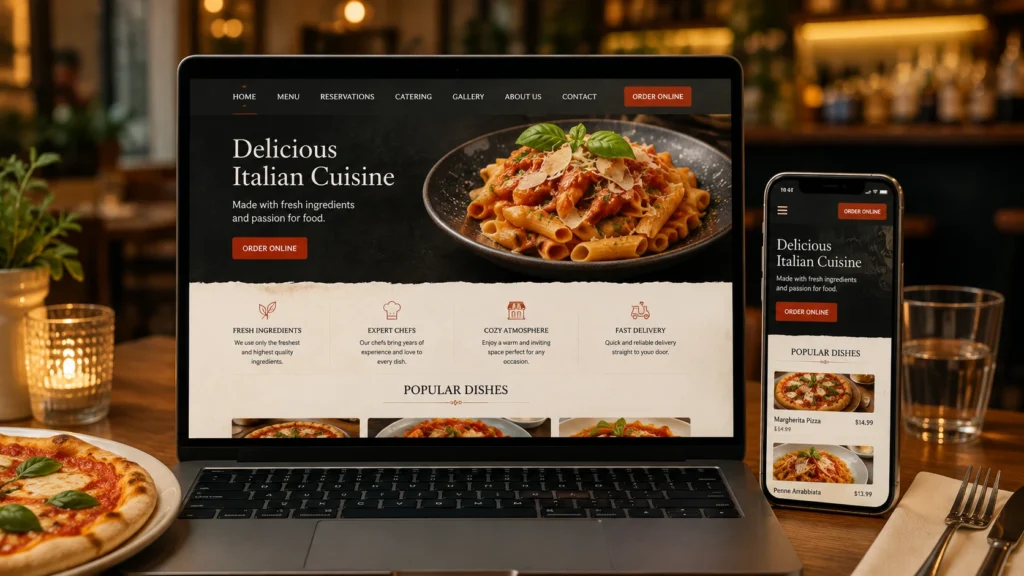
What a Great Digital Menu Looks Like
- Real HTML pages, not files to download – fast, tappable, and indexable
- Clear categories (starters, mains, vegan, kids) with sticky navigation
- Photos of your actual dishes – diners are 83% more likely to order items shown with photos, according to menu-platform data from Beyond Menu
- Dietary tags (V, GF, spicy) so guests can self-serve answers
- One-tap price and 86-item updates – no reprinting, no re-uploading
Online Ordering Integration: Own Your Orders, Keep Your Margins
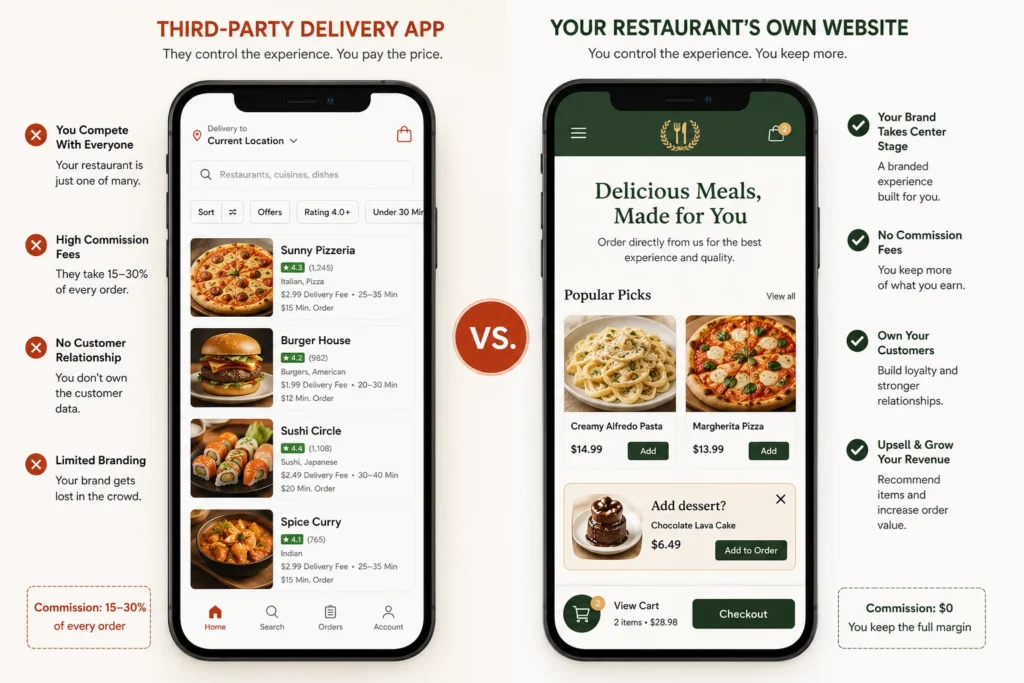
Third-party delivery apps typically take a 15-30% commission per order, and that’s before promoted placements and fees that erode already-thin margins. On a $40 order, that’s your entire profit on the food handing itself over to an app.
The good news? Customers actually prefer you. A majority – 58% – prefer ordering delivery directly from a restaurant’s own app or website, per NCR Voyix’s 2025 customer experience research.
What Good Ordering Integration Looks Like
- Guest checkout – never force account creation for a $22 order
- Three taps or fewer from menu item to confirmation
- POS sync (Toast, Square, Lightspeed) so orders hit the kitchen screen, not a fax machine
- Pickup, delivery, and table-side QR options from one menu
- Your branding, your upsells (“add tiramisu?”) – not a competitor’s ad
This is where professional restaurant web development pays for itself: the ordering system is wired into the site, the POS, and the menu from day one, so nothing breaks on a busy Saturday night.
Local SEO for Restaurants: Get Found at Dinner Time
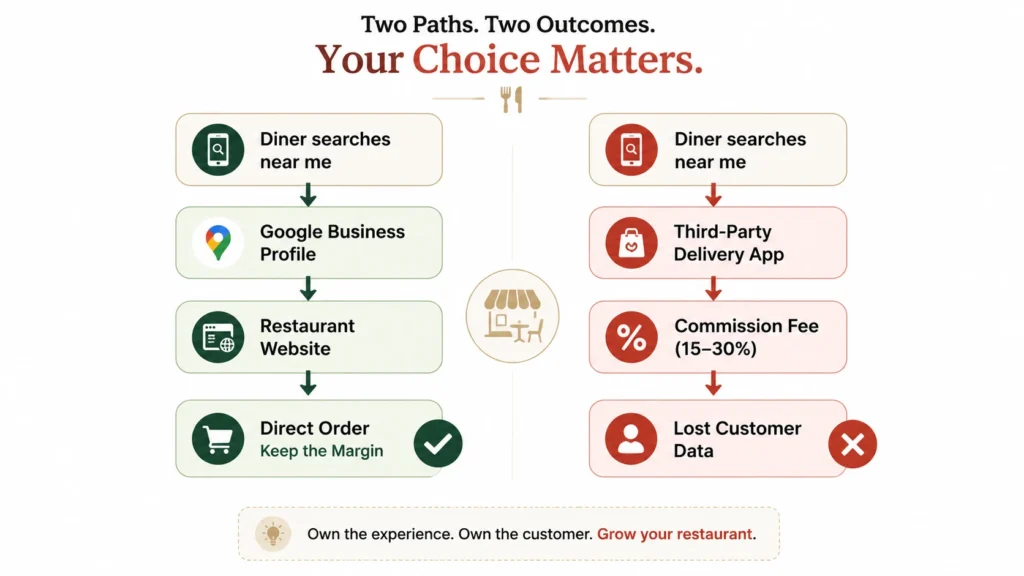
Most diners check Google before choosing where to eat, and your Google Business Profile is the first thing they see. Even better for you: 76% of mobile searchers visit a restaurant within 24 hours of their search. Local SEO for restaurants isn’t slow-burn branding – it’s tonight’s covers.
Sync Your Google Business Profile With Your Website
Google’s own guidance is clear: a complete, accurate Business Profile improves local ranking. “Sync” simply means your profile and your website never disagree.
- Hours on your site match your profile – including holiday hours, updated before the holiday
- Menu link on the profile points to your mobile menu page, not a PDF
- Photos on both show the same dishes you’re proud of this season
- Address and phone number identical everywhere (website footer, profile, directories)
- Review replies on Google, with a review link on your site’s thank-you pages
Pair that with location-specific pages (“wood-fired pizza in [Neighborhood]”) and menu schema markup, and you’re doing what most competitors won’t. It’s the same local playbook we’ve used to help a clinic website rank on page 1 of Google – hungry searches and patient searches behave surprisingly alike.
Third-Party Apps vs. Direct Ordering: The Real Math
| Factor | Third-Party Delivery Apps | Ordering on Your Own Website |
| Commission per order | 15-30%+ | Payment processing only (~2-3%) |
| Customer data | Owned by the app | Owned by you |
| Branding | Your logo next to 50 competitors | Your photos, your story |
| Menu updates | Re-upload per platform | Update once, live everywhere |
| Repeat orders | App promotes whoever pays | Your email/SMS list, your promos |
Apps still earn their place as a discovery channel for new customers. The mistake is letting them be your only channel.
Restaurant Website Mistakes That Cost You Covers
- PDF-only menus that mobile users can’t read and Google can’t rank
- Hours and address buried below the fold (or missing entirely)
- Stock photos of sushi when you serve steak
- Slow hero videos that eat mobile data before the menu loads
- No click-to-call or “Get Directions” button on mobile
- Ignoring reviews – or arguing with them publicly
How Vebrixa Approaches Restaurant Web Development
We build restaurant sites the way you run a good kitchen: everything in its place, nothing slowing service. Our Discover → Design → Develop → Launch & Grow process starts by learning your service style, your menu rhythm, and your neighborhood – then produces a fast-loading, mobile-first site with ordering and local SEO built in, not bolted on.
No hidden surprises, no jargon, and no launch-day abandonment. We stick around for the long term, because a menu – and a website – is never really finished.
Frequently Asked Questions
It depends on pages, ordering complexity, and integrations, but most restaurant sites fall between a simple menu site and a fully custom build with POS-connected ordering. The right question to ask any agency is what’s included – hosting, menu updates, SEO – so there are no surprises later.
Yes – apps are great for discovery, but direct ordering is where margin and customer loyalty live. Most successful restaurants keep both: apps bring new faces, their own site brings back regulars without a 30% fee attached.
Avoid it. PDFs are hard to read on phones, go stale quickly, and are nearly invisible to search engines. A live HTML menu with photos and dietary tags converts better and ranks; keep the printable PDF for the front desk only.
It’s often the first (and sometimes only) thing diners see – hours, photos, reviews, and a menu link in one card. Keeping it synced with your website is one of the highest-impact local SEO actions a restaurant can take.
A focused build typically takes 4-8 weeks, with photography and menu prep usually setting the pace. A structured process like Vebrixa’s keeps that timeline honest and gets you launching before the busy season, not after it.
Partially. Menu and hours can be structured on your site so Google reads them cleanly, and many POS/menu platforms push updates to your site and profile together. The goal is one source of truth so a guest never sees wrong hours or a retired special.
Your Website Is Open Even When You’re Closed
Restaurants win or lose online in the ten seconds between a hungry search and a readable menu. A mobile-first menu, commission-light direct ordering, and a synced Google Business Profile turn that window into reservations, orders, and regulars – not bounces.
Not sure if your site is filling tables or just sitting there? Get a free website audit from Vebrixa – we’ll show you what’s working, what’s leaking orders, and what to fix first. Honest answers, no pressure.