
FinTech Website Development: Security & UX Best Practices for 2026
Would you trust your life savings to a website that takes six seconds to load, breaks on mobile, and handles passwords over a shaky connection? Neither will your customers. In fintech website development and banking website design, trust isn’t a feature you bolt on at the end – it is the product.
And in 2026, the bar has never been higher. The global average cost of a data breach just hit a record $4.99 million. New EU and card-industry rules now dictate how financial sites must be built. And most of your customers will only ever see your platform on a phone.
Here’s how to build a financial website that’s secure, compliant, and converts.
Why Security Now Drives Fintech Website Development
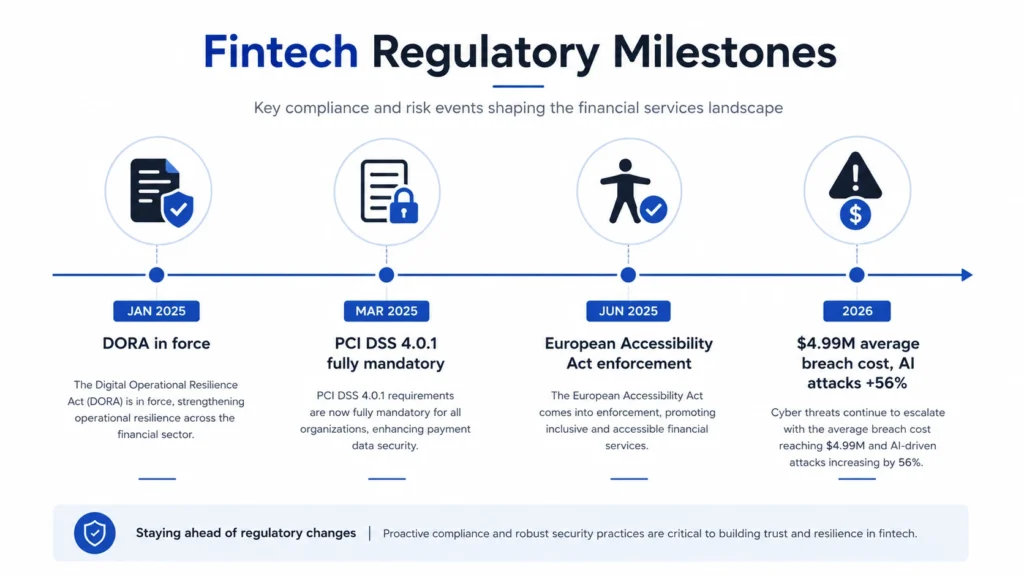
According to IBM’s Cost of a Data Breach Report 2026, the global average breach cost climbed 12% year-over-year to a record $4.99 million – nearly $11.5 million in the US alone. Financial services remains one of the most expensive industries to hit, at well over $6 million per incident, while AI-driven attacks (deepfake impersonation leading the pack) jumped 56%.
At the same time, three rule changes redefined what “done” means for a banking website:
- PCI DSS 4.0.1 – every requirement, including multi-factor authentication for all access to cardholder data, became mandatory on 31 March 2025.
- DORA – the EU’s Digital Operational Resilience Act, in force since January 2025, requires financial firms to report major ICT incidents within hours, not weeks.
- The European Accessibility Act (EAA) – enforced from 28 June 2025, with banking websites and apps explicitly in scope.
Security, compliance and accessibility are no longer IT side-projects. They’re design decisions – which is why serious fintech website development starts with architecture and risk, not colour palettes.
Security Best Practices for Fintech & Banking Websites in 2026
1. Encrypt everything, then encrypt it again
TLS 1.3 across the entire site with HSTS, encrypted backups, and tokenised card data. “HTTPS only” is the floor, not the finish line.
2. Make MFA the default – and make it painless
PCI DSS 4.0.1 now requires MFA across the cardholder data environment. For customers, prefer passkeys and biometrics over SMS codes: harder to phish, faster to use. Security and UX winning together.
3. Use risk-based (adaptive) authentication
Step up verification only when something looks unusual – a new device, a strange location, an oversized transfer. The 95% of legitimate logins stay friction-free; the risky 5% get checked.
4. Design for DORA’s clock, not just for uptime
DORA’s reporting chain – initial notification as early as 4 hours after classifying a major incident (and no later than 24 hours after detection), an intermediate report at 72 hours, a final report within a month – means your monitoring, logging and escalation playbooks must exist before launch. Your admin dashboards should make those reports easy to produce.
5. Guard the front door
A web application firewall (WAF) plus always-on DDoS protection absorbs the attacks that will inevitably come – including the AI-assisted ones.
6. Treat third-party scripts like contractors
Every analytics pixel, chat widget and payment SDK is supply-chain risk. Inventory them, load them securely, and review them quarterly.
7. Test like an attacker, patch like a professional
Regular penetration testing, dependency scanning and code reviews – with staging environments that mirror production without real customer data.
This is also where the right partner matters. Vebrixa bakes security, speed and SEO into one four-step process – Discover → Design → Develop → Launch & Grow – so nothing gets bolted on as an afterthought. You can see how we work on our About page.
Banking Website Design: UX Best Practices That Actually Convert
Security keeps you in business. UX grows it. Here’s what moves the needle in 2026:
Design mobile-first, because that’s where banking happens
Roughly 3.8 billion people worldwide now use mobile banking, and about two-thirds of Gen Z and Millennials say a mobile app is their primary banking channel, per the American Bankers Association. Design for the phone first, then scale up – never the reverse.
Treat speed as revenue, not vanity
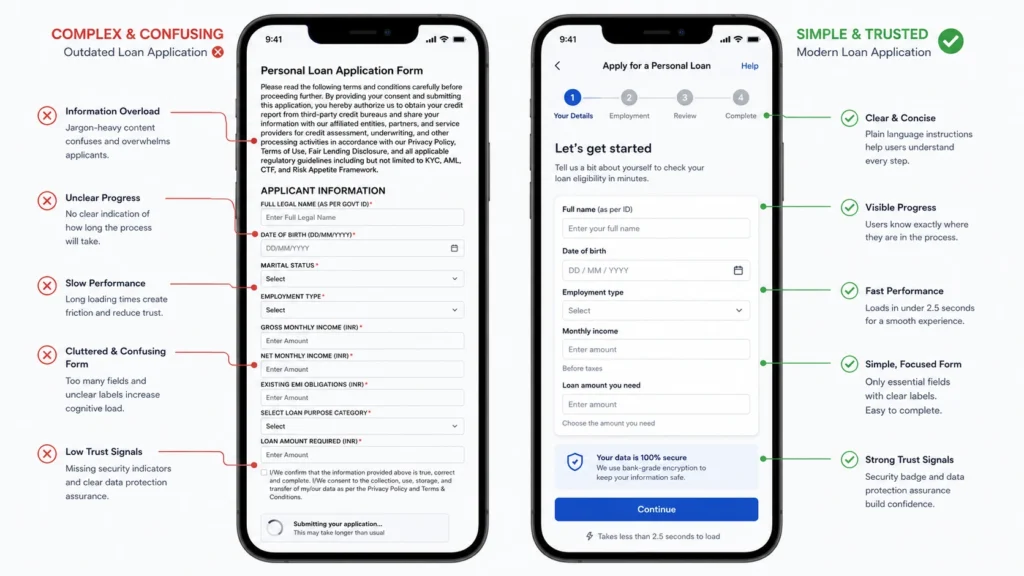
Google and Deloitte’s research found that a 0.1-second improvement in mobile load time lifted retail conversions by 8.4%, while separate analyses put a one-second delay at roughly a 7% conversion drop. On a bank or lending site, that’s the difference between an opened account and an abandoned form. Fast loading is also a ranking factor – speed is SEO.
Write like a human, disclose like a regulator
Plain-language fees, rates and risks beat jargon for both conversions and compliance. If a sentence wouldn’t survive a conversation with your grandmother, rewrite it.
Accessibility is now law – and a market
With the European Accessibility Act enforced, EU banking websites must work for keyboard-only users, screen reader users and low-vision customers. Aim for WCAG 2.2 AA: real contrast, visible focus states, proper form labels, reduced-motion support. Accessible flows convert better for everyone.
Put trust signals where decisions happen
Security messaging, recognisable compliance markers and a visible path to a real human belong next to forms and CTAs – not buried in the footer.
Design honest errors and graceful timeouts
Warn before a session expires, preserve entered data safely, and always explain the next step. A well-designed error state can save a customer; a blank one loses them for good.
The Security–UX Balance: Spend Friction Only Where Risk Is High
The best banking website design treats friction like a budget: you can’t afford to waste it on low-risk moments.
| Moment | Old-school approach | 2026 best practice |
| Login | SMS code every single time | Passkeys/biometrics, step-up checks only on risk |
| New payee / large transfer | No extra checks | Confirmation screen + out-of-band verification |
| Session timeout | Abrupt logout, data lost | 60-second warning + securely saved draft |
| Passwords | 14 characters, rotated every 60 days | Passkeys/SSO + breached-password screening |
| Accessibility | “Secure pages can’t be accessible” | Fully accessible flows, WCAG 2.2 AA |
Notice the pattern: modern security removes friction for legitimate users and concentrates it on the moments that actually carry risk.
Your 2026 Fintech Website Checklist
- TLS 1.3 + HSTS, WAF and DDoS protection
- MFA/passkeys with adaptive, risk-based step-up
- PCI DSS 4.0.1 alignment if you touch card data
- DORA-ready logging and incident playbook
- WCAG 2.2 AA / EAA accessibility pass
- Sub-2.5-second loads on mid-range mobiles
- Plain-language content with transparent fees
- Monitoring, pen testing and a maintenance plan after launch
That last point matters more than most teams expect. A fintech site is never “finished” – it’s maintained. That’s why Vebrixa’s web development and maintenance services follow a Launch & Grow model: we keep sites patched, fast and ranking long after go-live.
Frequently Asked Questions
It depends on scope: a marketing site for a financial consultancy is a very different build from a banking portal with logins, KYC and integrations. The honest answer is to budget for security reviews, compliance work and ongoing maintenance from day one – and be wary of any quote that ignores them. Vebrixa’s quotes break all of this down upfront, with no hidden surprises.
At a minimum: encryption everywhere (TLS 1.3 + HSTS), MFA, a WAF with DDoS protection, secure session handling, and logging plus monitoring. If you handle card payments, PCI DSS 4.0.1 applies; in the EU, DORA adds resilience and incident-reporting duties.
A focused marketing site is typically a matter of months; a full banking portal with secure onboarding, integrations, pen testing and compliance reviews is a longer program. A proper Discover phase upfront is what keeps either timeline honest.
If you serve EU consumers, almost certainly yes – banking services are explicitly in scope, and enforcement began on 28 June 2025. The cheapest path is designing and building to WCAG 2.2 AA from the start, rather than retrofitting later.
Yes. Speed alone moves the numbers: Google and Deloitte measured an 8.4% conversion lift in retail from a 0.1-second improvement. Add plain language, mobile-first flows and trust signals at decision points, and the effect compounds.
Treat security as a habit, not a launch task: scheduled updates, monitoring, pen testing and dependency reviews. That’s exactly what a Launch & Grow-style maintenance plan is for.
The Bottom Line: In 2026, Trust Is the Conversion Funnel
Fintech website development in 2026 is a trust exercise: record breach costs and AI-powered attacks make security your foundation, while speed, accessibility and plain language turn that foundation into growth. Get both right, and your website stops being a brochure and starts being your best-performing branch.
Not sure if your financial platform is building trust – or quietly leaking it? Get a free website audit from Vebrixa and we’ll show you exactly where you stand on security, speed and SEO. Prefer to read first? Our FAQs page covers the basics – and a real human always answers after that.