
Affordable Web Design for Startups: What You Actually Get for Your Budget
If you’ve ever searched for affordable web design for startups, you’ve probably met the same two extremes: a $29/month DIY builder on one side, and a $25,000 agency quote on the other. One risks making your business look amateurish. The other risks burning runway before you’ve found product–market fit.
The good news? The sensible middle ground is real – if you know what you’re actually buying.
Here’s the truth nobody in this industry says out loud: affordable should never mean cheap. It means every dollar you spend works toward something measurable – speed, trust, visibility on Google, and conversions.
In this guide, we’ll break down what you can realistically expect at every budget level, the non-negotiables any professional site must include, and the hidden costs that turn “bargain” websites into expensive mistakes.
Why Your Website Is Your Startup’s Hardest-Working Employee
Before we talk money, let’s talk stakes. Your website is often the first conversation you have with a customer, a journalist, or an investor – and research shows that 94% of first impressions are design-related, formed before a single word of your copy truly registers.
Separately, research reviewed by the NIH found that roughly 75% of people judge a company’s credibility based on how its website looks and reads.
For a startup, that’s brutal but fair: nobody knows your brand yet, so your site carries the entire burden of proof. It’s your pitch deck, your receptionist, and your sales rep – working 24/7, never calling in sick.
That’s why “budget-friendly” doesn’t mean “optional.” It means smart.
Affordable Web Design for Startups: What You Get at Each Budget Level
Let’s get concrete. According to Forbes Advisor’s website cost guide, a DIY build typically runs $0–$450, while professional design starts around $1,500 and climbs from there. Most small businesses spend between $2,000 and $20,000 for a professionally built site. Here’s what that money usually buys:
| Budget (USD / GBP) | What you typically get | Best for | Watch out for |
| DIY template builder – $0–$500 / £0–£400 | Stock template, drag-and-drop editor, basic hosting; you write, build and fix everything yourself | Founders validating an idea or running a short-term campaign | Slow load times, limited SEO control, an unmistakably “template” look |
| Freelancer – $500–$2,500 / £400–£2,000 | Customized template or light custom build, 5–8 pages, basic SEO setup | Startups that need a simple, decent site fast | Quality varies wildly; no backup if they disappear; strategy is on you |
| Boutique agency / pro studio – $2,500–$8,000 / £2,000–£6,500 | Custom UI/UX design, conversion-focused structure, technical SEO, speed optimization, CMS training, post-launch support | Budget-conscious startups that want to look (and rank) like the market leader | Get scope, revisions and ownership in writing |
| Established agency – $8,000–$25,000+ / £6,500–£20,000+ | Full strategy, branding, custom development, integrations, CRO programs | Funded startups with complex products or compliance needs | Overkill for most early-stage teams |
Most budget-conscious startups land in the middle two rows. The freelancer route can work – if you’re a good project manager.
The boutique studio route is where affordable web design for startups starts behaving like an investment instead of an expense, because speed, SEO and conversion thinking are included, not sold as add-ons.
The 6 Non-Negotiables in Affordable Web Design for Startups
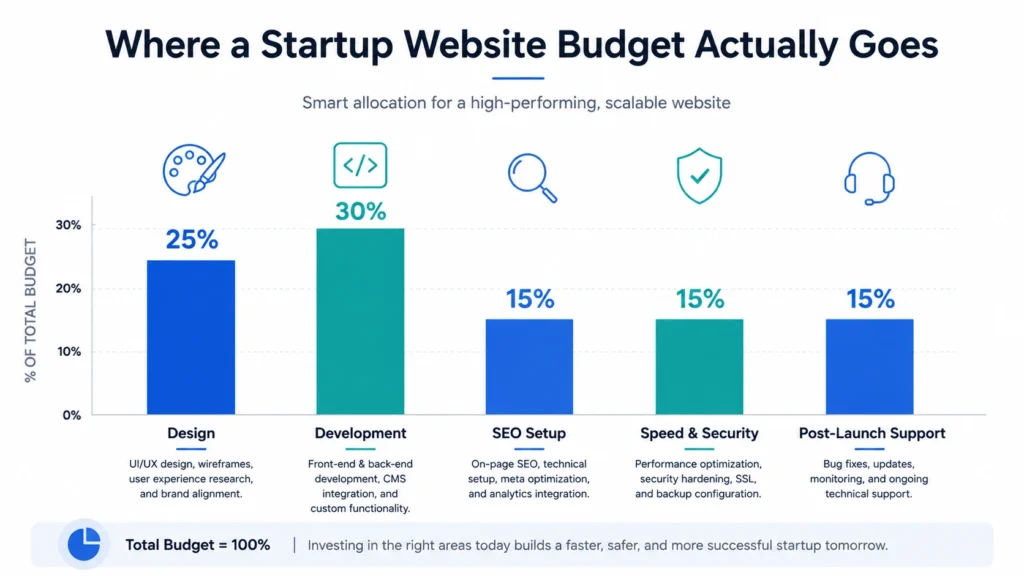
Whatever you pay, these six things should never be “extras”:
1. Mobile-first, responsive design. Well over 60% of global web traffic now comes from mobile devices. If your site looks broken on a phone, your business looks broken. Period.
2. Fast load times. Google’s research is blunt: 53% of mobile visits are abandoned if a page takes longer than three seconds to load. And the probability of a bounce jumps 32% as load time goes from one second to three. Speed isn’t a technical nicety – it’s a revenue lever (see Core Web Vitals for what Google measures).
3. SEO foundations baked in from day one. Clean heading structure, descriptive title tags, schema markup, an XML sitemap, keyword-mapped pages – the unglamorous basics in Google’s SEO starter guide that DIY builds usually skip. Retrofitting SEO after launch always costs more than building it in.
4. One clear conversion path per page. Every page should answer “what should I do next?” – book a demo, request a quote, download a guide. Frictionless contact forms and obvious CTAs beat clever design every single time.
5. Security and trust signals. HTTPS, a visible privacy policy, and – if you’re in FinTech or healthcare – compliance-conscious handling of forms and data. Trust is the currency startups borrow against.
6. Room to grow. A CMS and site architecture that lets you add a pricing page, a blog hub, or a booking system in month six – without rebuilding from scratch.
The Hidden Costs of a “Cheap” Website
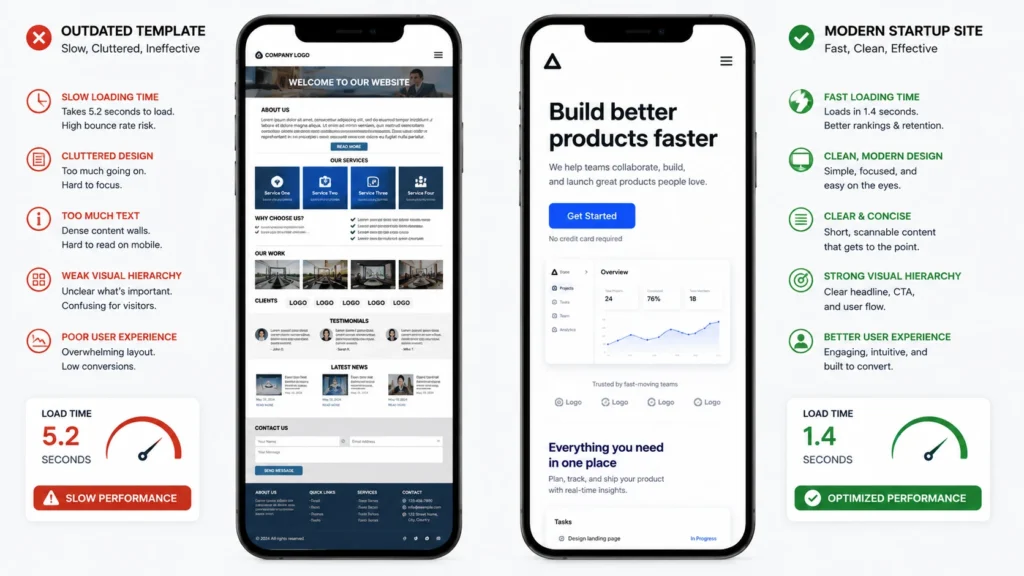
The sticker price is never the whole price. The most common ways bargain sites get expensive:
- The redo tax: launching fast on a template, then paying to rebuild 9-12 months later when it can’t scale.
- Invisibility on Google: no keyword structure or technical SEO means no organic traffic – so you rent attention with ads, forever.
- Surprise invoices: premium plugins, stock imagery, “basic” hosting that collapses under a traffic spike.
- Ownership traps: the domain registered in the developer’s name, or design files you never received.
- Opportunity cost: every week your site is slow or unclear, leads quietly choose a competitor who looks sharper.
This is exactly why honest scoping matters. At Vebrixa, everything – scope, timeline, deliverables – is agreed in writing before a single pixel is designed, because the way we work is built on no hidden surprises.
How to Get Professional Quality on a Startup Budget
Want agency-level output without an enterprise invoice? Here’s the playbook we recommend to early-stage founders:
- Start with the core 5–7 pages. Home, services/product, about, proof or case studies, contact – plus one SEO-focused blog hub. Depth can come later; clarity can’t.
- Spend where trust is made. Your homepage and money pages deserve custom design most.
- Bring content early. Copy delays are the #1 cause of launch delays. Rough drafts keep projects moving.
- Choose process over promises. A clear four-step process – Discover → Design → Develop → Launch & Grow – keeps budgets honest and surprises at zero.
- Build SEO in, don’t bolt it on. Ranking early compounds; retrofitting doesn’t.
- Plan for month six. Ask what adding a feature will cost later, not just what the build costs now.
That’s the model Vebrixa was built on: fast-loading, mobile-responsive, scalable websites with SEO wired in from the first wireframe – the same approach that has helped clients, like a healthcare clinic, reach page 1 of Google. You can see the full breakdown on our web development and UI/UX services page.
Frequently Asked Questions
For a professional, conversion-ready site, most startups should budget $1,500–$8,000 (£1,200–£6,500). Below that, you’re typically in DIY or basic-freelancer territory; above it, you’re paying for strategy, integrations and custom development that early-stage teams rarely need yet.
Sometimes – usually a skilled freelancer customizing a premium template. It can look decent, but expect trade-offs in SEO depth, speed tuning and originality, and make sure you own the domain, hosting and design files from day one.
They’re fine for validating an idea or running a short-term campaign. The limits appear when you scale: less control over technical SEO, slower performance under heavy plugins, and a design that looks like everyone else’s. Many founders start there and migrate once traction arrives.
A template or freelancer build typically takes 2–6 weeks; a boutique agency with a structured process usually lands at 4–8 weeks, including discovery, design, development and testing. Be wary of anyone promising a fully custom site in a few days – that speed usually means cut corners.
Yes, directly and indirectly. Speed, mobile responsiveness and site structure are ranking signals, while good design keeps visitors on the page – which Google notices. It’s why Vebrixa bakes SEO into design and development instead of treating it as an afterthought.
Cheap cuts corners you’ll pay for later – skipped SEO, slow hosting, no support. Affordable means prioritizing what drives results (speed, mobile UX, SEO, conversions) inside a sensible budget. One is a discount; the other is a strategy.
(Looking for more quick answers? Visit our FAQs page.)
The Bottom Line on Affordable Web Design for Startups
Affordable web design for startups isn’t about spending as little as possible – it’s about spending where it counts: fast load times, mobile-first design, SEO foundations, and clear conversion paths. Get those right inside a realistic $1,500–$8,000 budget, and your website stops being a cost center and starts being your best hire.
Not sure what your budget should buy – or whether your current site is holding you back? Get a free quote and an honest website review from Vebrixa. We’ll tell you exactly what you need, what you don’t, and what it costs. No surprises, no pressure.